
Bassoon Fingerings: What Your Band Book Gets Wrong
For a beginning bassoonist, it is natural to assume that the fingerings on the fingering chart in a band method book have been carefully checked by someone who knows the instrument. Unfortunately, that isn’t always the case.
Some of the bassoon fingerings printed in common band method books are wrong. They are often simplified versions of a quality fingering but are not the fingerings that a bassoonist would normally teach or recommend. And some of the most important technique needed to play certain notes are barely explained—or aren’t explained at all.
This matters for students, but it also matters for band directors. If you don’t play bassoon, you may have no reason to question the fingering chart in the method book. Your student may be struggling with a note, and it can look like a problem with the student’s technique when the real problem is the fingering they were given.
Here are some of the notes that deserve a closer look.
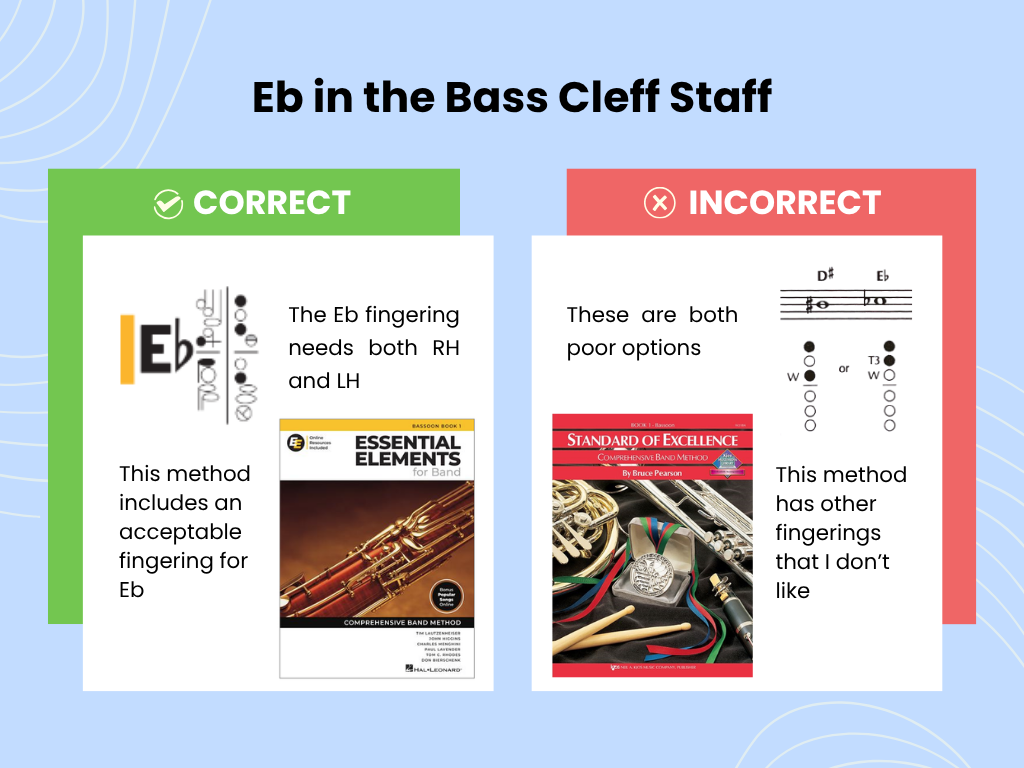
E♭ in the Bass Clef Staff
E♭ in the bass clef staff is one of the most troublesome notes you’ll encounter on a beginning bassoon fingering chart. I’ve seen many band method books with terrible E♭ fingerings.
The fingering on the left uses both the right and left hands. Adding the right hand increases accuracy in both pitch and stability. If the right hand is left off (as is shown in the incorrect band method example), students will be frustrated and assume that any difficulty they have producing the note is their own fault, which isn’t the case.
For students, the lesson is simple: if your E♭ is difficult to produce, unstable, or consistently gives you problems, check the fingering before assuming that you are the problem.
For band directors, this is a good example of why a bassoon-specific fingering chart is worth having available to your students.
A, B♭, B, and C at the Top of the Staff
The notes from A through C at the top of the bass clef staff introduce another issue: flicking.
These notes are particularly important because the bassoon’s register mechanism requires a technique that beginning players need to learn—not simply a fingering that they need to memorize.
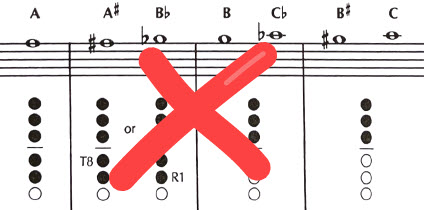
Many band method books give students the fingerings for these notes without adequately teaching the flicking (or “venting”) technique that goes with them.
Flicking overcomes the lack of an octave key on the bassoon. If you look at the fingerings above, you’ll notice that they are the same as the notes for the octave below. You can’t overblow on a bassoon and hope that the upper octave comes out. That’s not the way the instrument works.
Your band method’s fingering chart answers the question, “Where do my fingers go?”
It does not answer the question, “How do I get this note to come out in the right octave and speak cleanly when I move to it from another note?”
What Is Flicking?
This is also an area where a band director can make a huge difference simply by knowing that the technique exists. If a student is having trouble with these notes, don’t assume that more repetition of the printed fingering will solve the problem.
Sometimes the student has been taught the wrong thing—or hasn’t been taught the necessary technique at all. Flicking is part of the fingering for A, B♭, B, and C at the top of the staff even though it isn’t represented on fingerings charts.
F♯ Above the Staff
F♯ above the staff presents another common fingering-chart problem. There are six ways to play F♯. The best option is to work with a bassoon teacher to find the fingering that works best for your bassoon.
As with E♭, this is a good reminder that bassoon fingerings aren’t simply a matter of following whatever happens to appear in the back of a general band method book.
A Fingering Chart Is a Starting Point—not the Whole Story
Bassoon students deserve bassoon-specific information.
Band directors don’t need to become professional bassoonists to help their bassoon students, but they should know when the general band method book isn’t enough. Having a reliable bassoon fingering chart available can prevent students from spending weeks practicing a fingering that is inefficient, unreliable, or simply incorrect.
If you are a student and a fingering feels strange, a note consistently doesn’t respond, or you are having trouble making a particular passage work, don’t automatically assume that you’re doing something wrong. Your fingering chart might be wrong.
The Bottom Line
The fingering chart in your band method book may be convenient, but that doesn’t make it authoritative.
For bassoonists, particularly beginners, use a fingering chart created or approved by a knowledgeable bassoonist. Learn the standard fingerings first, understand when alternate fingerings are appropriate, and learn the techniques—such as flicking—that cannot be explained adequately by a list of keys.
The goal isn’t to make learning bassoon more complicated.
It’s to make sure students are learning the instrument correctly from the beginning.
If you’re a student, keep this reliable chart in your case.
If you’re a band director, print this out for your bassoonists.
And if the fingering in the band book doesn’t work right, don’t be afraid to question the book.